London, Ontario, is increasingly popular among young professionals seeking vibrant city life with suburban comfort. With a growing economy, affordable housing options, and proximity to work and education, the city offers an ideal environment to start and grow careers.
Many neighborhoods in London combine modern amenities, lively social scenes, and convenient transport. Young adults benefit from cultural events, fitness centers, and cafes that cater to professional lifestyles.
Property prices are competitive compared to larger Canadian cities, allowing young professionals to find stylish apartments and shared housing. Parks, trails, and recreational facilities offer opportunities to maintain a healthy work-life balance while staying connected to urban hubs.
In this guide, we explore the best neighborhoods in London, Ontario for young professionals, highlighting accessibility, lifestyle, safety, and social opportunities. Each area includes detailed descriptions, pros and cons, and local insights to help young professionals choose the perfect place to live.
10 Best Neighborhoods In London Ontario For Young Professionals
1. Old East Village – Best for Creative Professionals
Old East Village – Best for Creative Professionals
Old East Village is a hub for artistic and creative young professionals. The neighborhood is known for its vibrant murals, galleries, and boutique shops. Its walkable streets make it easy to explore local coffee shops and coworking spaces.
Housing options include renovated lofts and affordable apartments perfect for young adults. The area hosts frequent art festivals, live music events, and community workshops. Its eclectic vibe encourages networking and collaboration among creative professionals.
Safety has improved in recent years, with community programs fostering engagement and a strong sense of local pride. Transit connections to downtown London and the university district are convenient. The neighborhood combines culture, convenience, and social energy.
Pros:
• Creative hub
• Walkable streets
• Affordable apartments
• Art events
• Good transit
• Local cafes
• Community vibe
Cons:
• Noise levels
• Limited parking
• Smaller parks
2. Wortley Village – Best for Young Professionals Seeking Charm
Wortley Village – Best for Young Professionals Seeking Charm
Wortley Village offers a mix of historic charm and modern convenience. Streets lined with heritage homes create a cozy and picturesque atmosphere. Young professionals enjoy cafes, boutique shops, and fitness studios within walking distance.
The area is known for excellent local restaurants, pubs, and cultural events. Access to downtown London is quick via car or public transit. Community engagement programs make it ideal for networking and building connections.
Safety is high, with family-run businesses contributing to a friendly neighborhood. Housing includes affordable apartments and shared houses for professionals. Wortley Village balances character with urban amenities.
Pros:
• Historic charm
• Walkable streets
• Local cafes
• Restaurants & pubs
• Transit access
• Safe area
• Community vibe
Cons:
• Limited nightlife
• Smaller apartments
• Higher rent
3. Soho – Best for Young Tech Professionals
Soho – Best for Young Tech Professionals
Soho is a modern neighborhood attracting tech-savvy young professionals. Its proximity to business parks and coworking hubs makes commuting easy. Cafes and casual restaurants provide ideal spaces for work meetings and networking.
High-speed internet and modern apartment buildings appeal to tech-focused residents. Parks and green spaces offer outdoor recreation. Transit links to the university and downtown simplify daily travel.
The area encourages collaboration through local meetups and tech events. Safety and cleanliness are top priorities. Soho blends convenience with a dynamic professional atmosphere.
Pros:
• Tech hubs
• Fast internet
• Modern apartments
• Parks nearby
• Transit access
• Networking events
• Safe environment
Cons:
• Higher rent
• Limited historic charm
• Smaller green areas
4. Byron – Best for Young Professionals Seeking Suburban Peace
Byron – Best for Young Professionals Seeking Suburban Peace
Byron is a quiet, suburban neighborhood ideal for young professionals seeking respite from urban bustle. Tree-lined streets and larger apartment complexes offer a peaceful environment. Access to grocery stores, gyms, and coffee shops keeps life convenient.
Housing is affordable, with modern apartments and condos available. The neighborhood is family-friendly yet welcoming to young adults. Parks and walking trails promote a balanced, healthy lifestyle.
Public transit links and major roads connect Byron to downtown London. Safety and low traffic make it perfect for early-career professionals. Byron combines suburban calm with professional convenience.
Pros:
• Affordable housing
• Quiet streets
• Green spaces
• Transit access
• Local amenities
• Safe area
• Balanced lifestyle
Cons:
• Limited nightlife
• Fewer coworking spaces
• Longer commute
5. Downtown London – Best for Nightlife and Social Professionals
Downtown London – Best for Nightlife and Social Professionals
Downtown London is perfect for young professionals who value social life. Bars, restaurants, and live music venues create a dynamic atmosphere. Apartments and condos provide modern urban living with easy access to work.
Transit options are abundant, including bus routes and cycling paths. Downtown hosts cultural festivals, markets, and networking events. Safety varies by street but is generally good in residential pockets.
The area attracts ambitious professionals seeking vibrant work-life balance. Fitness centers, coworking spaces, and coffee shops are plentiful. Downtown combines convenience with excitement for young adults.
Pros:
• Nightlife hub
• Walkable streets
• Modern condos
• Transit access
• Cultural events
• Fitness centers
• Coworking spaces
Cons:
• Noise levels
• Higher rent
• Limited green areas
6. Old North – Best for Young Professionals Near University
Old North – Best for Young Professionals Near University
Old North is close to Western University and Fanshawe College, attracting students and young professionals. Affordable housing and shared apartments are widely available. The area has local cafes, fitness centers, and grocery stores within walking distance.
Safety is reasonable, with active neighborhood associations. Parks and recreational facilities provide options for leisure and exercise. Public transit links simplify commutes to downtown and surrounding areas.
Old North fosters a social and active environment for career starters. Networking opportunities abound through university-affiliated programs. It’s ideal for young adults starting their professional journey.
Pros:
• Affordable housing
• Near universities
• Local cafes
• Transit access
• Parks nearby
• Social environment
• Networking
Cons:
• Noise levels
• Limited parking
• Older buildings
7. Westmount – Best for Young Professionals Seeking Upscale Vibes
Westmount – Best for Young Professionals Seeking Upscale Vibes
Westmount is a stylish neighborhood offering upscale living with modern apartments. Young professionals enjoy boutique shops, cafes, and fitness centers. The area is close to downtown, ensuring convenience for work and social life.
Green spaces and tree-lined streets create a comfortable living environment. Housing options are more expensive but include high-quality apartments and condos. Transit access makes commuting simple.
Westmount balances upscale living with social vibrancy. Safety and community engagement enhance the appeal for professionals.
Pros:
• Upscale apartments
• Transit access
• Cafes & shops
• Parks nearby
• Social vibe
• Safe area
• Close to downtown
Cons:
• Higher rent
• Limited nightlife
• Smaller apartments
8. Masonville – Best for Professionals Seeking Shopping & Convenience
Masonville – Best for Professionals Seeking Shopping & Convenience
Masonville offers a suburban feel with excellent access to shopping and professional amenities. The Masonville Mall provides dining, retail, and entertainment options. Parks and recreational facilities are nearby, supporting an active lifestyle.
Apartments and condos are modern and suitable for young professionals. Transit connections to downtown and nearby business hubs are convenient. Safety is high, making it a reliable choice.
Masonville balances convenience with quality living. Social spaces and retail options make it appealing to young adults.
Pros:
• Shopping access
• Modern apartments
• Parks nearby
• Transit access
• Safe area
• Local amenities
• Active lifestyle
Cons:
• Higher rent
• Limited nightlife
• Suburban feel
9. Huron Heights – Best for Budget-Friendly Young Professionals
Huron Heights – Best for Budget-Friendly Young Professionals
Huron Heights provides affordable housing options for early-career professionals. Apartments and shared houses are available at lower rents. Local grocery stores, fitness centers, and cafes support a convenient lifestyle.
Transit links are available to downtown and nearby business districts. Parks and community facilities encourage outdoor activity. Safety is reasonable and improving with community engagement.
This neighborhood is perfect for budget-conscious young adults. Convenience and affordability make it a strong option for professionals starting their careers.
Pros:
• Affordable housing
• Transit access
• Parks nearby
• Local cafes
• Community vibe
• Fitness centers
• Safe area
Cons:
• Older buildings
• Limited nightlife
• Smaller apartments
10. Cherryhill – Best for Young Professionals Seeking Community
Cherryhill – Best for Young Professionals Seeking Community
Cherryhill offers a strong sense of community with modern housing and local amenities. Cafes, parks, and fitness facilities make it ideal for active young professionals. Its quiet streets ensure a balance of work and relaxation.
Apartments and condos are suitable for singles and roommates. Transit links provide access to downtown and surrounding business hubs. Safety and community programs make it appealing for professional living.
Cherryhill combines convenience, social opportunities, and peaceful living. It’s perfect for young adults seeking balance and connections.
Pros:
• Community vibe
• Modern apartments
• Parks nearby
• Transit access
• Cafes & shops
• Safe area
• Quiet streets
Cons:
• Higher rent
• Limited nightlife
• Smaller units
FAQs – Best Neighborhoods in London, Ontario for Young Professionals
1. Which neighborhoods are most affordable?
Huron Heights, Old North, and Masonville offer budget-friendly options with convenient access to work.
2. Which areas have the best nightlife?
Downtown London and Old East Village are ideal for young professionals seeking active social lives.
3. Which neighborhoods are safest?
Westmount, Cherryhill, and Byron have low crime rates and strong community programs.
4. Where is best for young professionals in tech?
Soho and Downtown London are close to tech hubs, coworking spaces, and networking events.
5. Which neighborhoods are most walkable?
Old East Village, Wortley Village, and Downtown London offer walkable streets with cafes, shops, and amenities.
6. Which areas are best near universities?
Old North and Downtown London are near Western University and Fanshawe College.
7. Which neighborhood combines affordability and social life?
Masonville and Huron Heights balance budget-friendly housing with access to local events and social hubs.
Conclusion
In conclusion, Old East Village is the best neighborhood in London, Ontario for young professionals due to its vibrant culture, walkability, and networking opportunities. The runner-up, Wortley Village, provides charm, accessibility, and community engagement for professionals starting their careers.
These areas provide excellent transit, amenities, and social options. Downtown and Soho offer nightlife and tech-friendly environments, while Masonville and Huron Heights are budget-conscious alternatives.
Choosing a neighborhood depends on your lifestyle priorities, such as affordability, social life, or proximity to work. Each neighborhood was selected for its ability to support a young professional’s career and social needs.
Explore these neighborhoods to find your perfect home in London, Ontario, and enjoy a vibrant, connected lifestyle as a young professional.
10 Best Places to Live South of London for Families
Living south of London offers families a balance of suburban comfort and easy access to the city. Many neighborhoods boast excellent schools, parks, and safe streets, making them ideal for raising children.
These areas combine vibrant local amenities with a tranquil environment, perfect for family life. Green spaces, sports clubs, and cultural activities enhance the quality of life and create strong community bonds.
Property options range from modern apartments to spacious family homes, offering value for money compared to central London. Excellent transport connections ensure commuting is convenient while still enjoying a quieter lifestyle.
In this guide, we explore the best places to live south of London for families, highlighting schools, community facilities, parks, and transport links. Each area includes a detailed overview, lifestyle insights, and pros and cons to help families make informed choices.
10 Best Places to Live South of London for Families
1. Wimbledon – Best Suburb for Family Lifestyle
Wimbledon – Best for Family Lifestyle
Wimbledon is renowned for its green spaces, top schools, and vibrant community atmosphere. The area blends suburban tranquility with a bustling town center. Families benefit from parks, cafes, and excellent transport links to central London.
Wimbledon Common offers vast open spaces for outdoor activities, while local sports clubs support children’s development. The area hosts community events and family-friendly activities throughout the year. Safety levels are high, adding to its appeal as a family-friendly suburb.
Top-rated schools like King’s College School and Wimbledon High School attract families seeking quality education. Shops, restaurants, and recreational facilities cater to all ages. Overall, Wimbledon combines lifestyle, education, and convenience for family living.
Pros:
• Excellent schools
• Green spaces
• Family events
• Good transport
• Low crime
• Community vibe
• Leisure facilities
Cons:
• High prices
• Limited parking
• Busy weekends
2. Kingston upon Thames – Best Riverside Family Town
Kingston upon Thames – Best for Riverside Lifestyle
Kingston upon Thames offers a mix of riverside living and suburban convenience. Families enjoy scenic views along the Thames and a bustling town center. Excellent schools, parks, and shopping facilities make it a top choice south of London.
The area has strong transport links, including train services to London Waterloo and frequent bus connections. Large green spaces, such as Richmond Park nearby, provide ample recreational opportunities. Local markets, cafes, and community activities enhance family life.
Kingston’s safety record is strong, and community programs support children and youth. Parents appreciate the balance of urban amenities and quiet residential areas. Riverside walks and leisure centers make it ideal for active families.
Pros:
• Riverside views
• Excellent schools
• Green spaces
• Good transport
• Community events
• Shopping options
• Safe environment
Cons:
• Expensive homes
• Traffic congestion
• Crowded weekends
3. Richmond – Best Scenic Family Neighborhood
Richmond – Best for Scenic Living
Richmond combines historical charm with modern amenities, offering families a high-quality lifestyle. Its proximity to Richmond Park provides endless outdoor activities. The area is well-known for excellent primary and secondary schools.
Public transport is efficient, with train and Underground options to central London. Richmond town center offers boutique shops, cafes, and restaurants suitable for family outings. Local community events and festivals further enhance the family-friendly vibe.
Safety and cleanliness are high priorities in Richmond. Its riverside walks, sports facilities, and cultural centers make it ideal for active families. Families enjoy both privacy and accessibility in this leafy suburb.
Pros:
• Scenic views
• Richmond Park
• Excellent schools
• Transport links
• Community events
• Safe area
• Cultural activities
Cons:
• High cost
• Limited parking
• Busy tourist season
4. Sutton – Best Affordable Family Area
Sutton – Best for Affordable Family Living
Sutton is a suburban town offering affordable housing and strong schools. Families benefit from parks, sports centers, and family-friendly activities. The town has a community-focused atmosphere suitable for raising children.
Excellent primary and secondary schools make Sutton attractive to families seeking educational opportunities. Public transport to London is convenient, with frequent train services. Local shops, libraries, and leisure centers support family life.
The area is known for safety and well-maintained streets. Parks such as Carshalton Park offer recreational spaces. Sutton balances affordability with quality family living south of London.
Pros:
• Affordable homes
• Excellent schools
• Green spaces
• Good transport
• Community vibe
• Leisure facilities
• Safe streets
Cons:
• Limited nightlife
• Smaller shops
• Less scenic
5. Croydon – Best Large Suburban Family Town
Croydon – Best for Family Convenience
Croydon is a large suburban town with excellent transport and shopping facilities. Families enjoy parks, playgrounds, and sports clubs. Schools in Croydon are diverse and cater to different needs.
The area benefits from fast trains to London, tram services, and major roads. Croydon offers a range of cultural activities, including theatres and museums. Safety varies by neighborhood, but many areas are family-friendly.
Local amenities support day-to-day family life, including supermarkets and healthcare facilities. Croydon is suitable for families needing space and convenient city access. Affordable options make it appealing for larger households.
Pros:
• Good transport
• Parks & playgrounds
• Cultural activities
• Shopping facilities
• Schools variety
• Affordable homes
• Family events
Cons:
• Some busy areas
• Variable safety
• Limited green spaces
6. Epsom – Best for Schools and Parks
Epsom – Best for Education & Parks
Epsom offers high-quality schools and spacious parks, ideal for families. The town is famous for Epsom Downs and local recreational facilities. Families enjoy a safe, community-oriented environment.
Public transport provides easy commuting options to central London. Local amenities include supermarkets, healthcare, and sports facilities. Community events strengthen neighborhood bonds.
Epsom combines convenience, safety, and educational opportunities. Its suburban charm appeals to families wanting green spaces. The town is a strong contender for the best family-friendly areas south of London.
Pros:
• Top schools
• Green spaces
• Safe area
• Transport links
• Community vibe
• Leisure centers
• Local amenities
Cons:
• Property cost
• Limited nightlife
• Occasional traffic
7. Reigate – Best Peaceful Family Suburb
Reigate – Best for Peaceful Living
Reigate is a quiet suburb known for safety, greenery, and good schools. Families enjoy a relaxed lifestyle with easy access to parks and open spaces. Community activities and clubs support children’s development.
Excellent schools, both state and private, attract families to the area. Transport options to London are convenient via train and bus links. Local shops and cafes offer family-friendly services.
Reigate is highly regarded for its balance of peace and accessibility. Parks and walking trails enhance family life. The town combines suburban calm with city convenience.
Pros:
• Peaceful area
• Good schools
• Green spaces
• Community activities
• Transport links
• Family-friendly shops
• Safe streets
Cons:
• High prices
• Limited nightlife
• Smaller town
8. Bromley – Best Large Family-Friendly Town
Bromley – Best for Active Families
Bromley offers excellent schools, shopping facilities, and sports amenities. Families enjoy parks, leisure centers, and community events. The town is safe and welcoming, ideal for raising children.
Transport connections to central London are efficient via train and bus services. Bromley’s town center provides restaurants, cafes, and cultural venues. Children benefit from diverse recreational options.
The area balances suburban living with vibrant town facilities. Parks and playgrounds encourage outdoor activities. Bromley remains one of the top family-friendly towns south of London.
Pros:
• Excellent schools
• Parks & playgrounds
• Good transport
• Shopping & dining
• Safe area
• Community events
• Leisure facilities
Cons:
• Crowded town center
• Traffic peak times
• Expensive homes
9. Beckenham – Best Suburban Lifestyle
Beckenham – Best for Suburban Comfort
Beckenham offers a suburban feel with excellent schools and parks. Families benefit from green spaces, leisure centers, and a friendly community. Public transport provides convenient commuting options.
Local amenities include shops, healthcare, and cultural facilities suitable for families. Community programs and clubs enhance children’s social development. The town maintains a safe and welcoming environment.
Beckenham is a practical choice for families seeking suburban tranquility near London. Its balance of amenities, transport, and lifestyle make it highly appealing.
Pros:
• Green spaces
• Excellent schools
• Safe streets
• Community clubs
• Good transport
• Local amenities
• Family-friendly
Cons:
• Limited nightlife
• Smaller town center
• Higher property cost
10. Dulwich – Best Historic Family Suburb
Dulwich – Best for Historic & Family Lifestyle
Dulwich combines historic charm with excellent schools and family-friendly parks. The area offers cultural attractions, museums, and theatres suitable for children. Families benefit from a safe, welcoming environment.
Transport connections include trains and buses to central London. Local amenities include shops, cafes, and medical facilities. Community programs support children’s development and social life.
Dulwich is highly regarded for education, culture, and lifestyle. Its historic architecture and green spaces enhance family living. Families enjoy both accessibility and a tranquil suburban environment.
Pros:
• Historic charm
• Excellent schools
• Parks & playgrounds
• Cultural attractions
• Good transport
• Safe environment
• Community programs
Cons:
• Expensive properties
• Limited parking
• Busy weekends
FAQs – Best Places to Live South of London for Families
1. Which suburb has the best schools?
Wimbledon, Richmond, and Dulwich are known for top-rated schools. These areas provide high academic standards and extracurricular opportunities. Families often prioritize these suburbs for educational benefits.
2. Which area is most affordable?
Sutton and Croydon offer more affordable housing options compared to Wimbledon or Richmond. They still provide good schools and family-friendly amenities.
3. Which area is safest for families?
Wimbledon, Richmond, and Reigate have low crime rates and strong community engagement. Safety makes these towns highly attractive for families.
4. Which suburbs offer the most green spaces?
Richmond, Wimbledon, and Epsom provide large parks, commons, and recreational areas. Green spaces encourage outdoor activities for children.
5. Which areas have best transport links to London?
Kingston, Croydon, and Bromley offer excellent trains and bus services to central London. These suburbs balance suburban life with commuting convenience.
6. Which suburb is ideal for active families?
Bromley and Beckenham offer sports facilities, leisure centers, and outdoor programs for children. Active lifestyles are easily supported here.
7. Are there community programs for children?
Yes, most suburbs including Wimbledon, Dulwich, and Beckenham provide clubs, cultural programs, and youth events. Families benefit from strong community support.
Conclusion
In conclusion, Wimbledon emerges as the best suburb south of London for families due to its green spaces, schools, and vibrant community. Kingston upon Thames is the runner-up, offering excellent riverside living and transport connections.
Both areas provide strong educational opportunities, safe neighborhoods, and recreational amenities. Families can enjoy parks, sports clubs, and cultural activities in these highly rated suburbs.
Other areas such as Richmond, Sutton, and Epsom also offer unique benefits, balancing affordability, scenic beauty, and educational quality. Each suburb was chosen for its ability to support family life while maintaining accessibility to London.
Choosing the right area depends on priorities such as budget, schools, transport, and lifestyle. Explore these suburbs to find the perfect home for your family south of London and experience a high quality of life.
Who Is The CEO Of Microsoft Gaming? Asha Sharma

BOM Radar Brisbane 128km Mt Stapylton Queensland’s Weather Eye
The Bureau of Meteorology (BOM) radar at Brisbane 128km Mt Stapylton is a critical component of Australia’s weather observation system, providing real‑time radar data for rainfall, storms, and atmospheric motion across southeastern Queensland. As one of the most important weather radars serving the Greater Brisbane region, Mt Stapylton helps meteorologists, emergency services, and residents track precipitation intensity and storm movement with precision.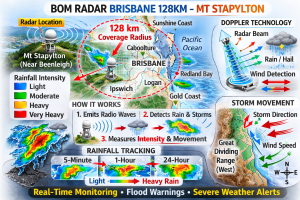
Australia’s weather patterns are highly dynamic, with tropical systems, thunderstorms, and seasonal weather fronts all influencing local conditions. The Mt Stapylton radar plays a major role in detecting and monitoring these changes, allowing forecasts and warnings to be delivered promptly and accurately to communities across the state.
The 128km radar is part of a broader national radar network, which together provides comprehensive coverage of real‑time rainfall and wind conditions. This network supports critical decision‑making for flood response, disaster preparedness, aviation safety, and daily weather forecasting.
In this guide, we’ll explore how the 128km BOM radar at Brisbane Mt Stapylton works, its coverage and technology, how to interpret radar data, how it aids local weather forecasting, and key questions about its operation and applications.
BOM Radar Brisbane 128km Mt Stapylton: The Complete Guide to Queensland’s Weather Eye
What Is the BOM Radar at Brisbane 128km Mt Stapylton?
The BOM radar at Brisbane Mt Stapylton is a Meteor 1500 S‑band Doppler weather radar that provides continuous observation of rainfall and wind data over a wide area of southeastern Queensland.
It is strategically sited on an isolated hill approximately 150 metres above sea level just east of Beenleigh, offering optimal coverage of the Brisbane Valley and surrounding regions. This location was chosen because its elevation provides excellent low‑level radar visibility across the metropolitan area and adjacent hinterland.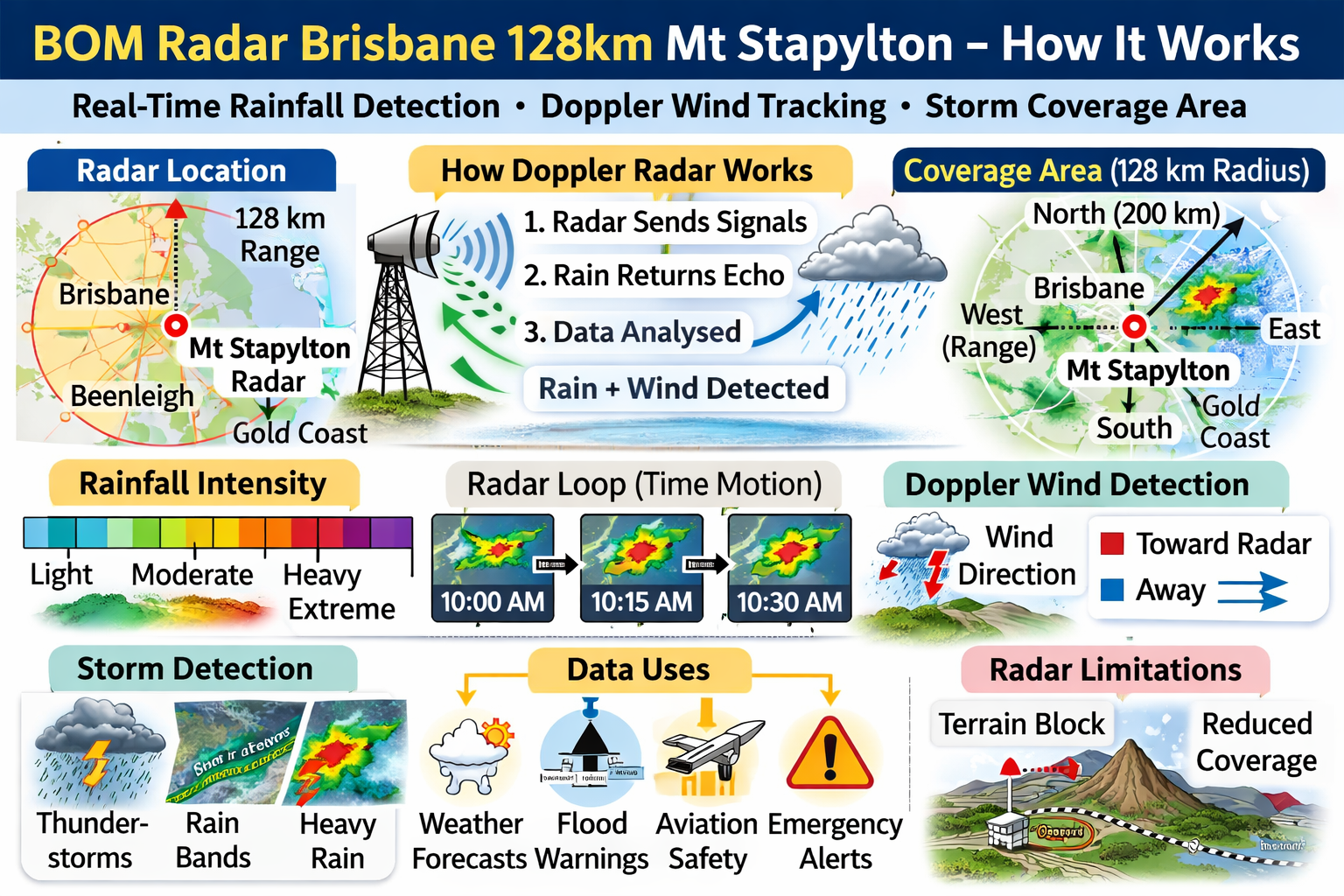
Using Doppler technology, this radar detects not only the intensity of precipitation but also the movement of raindrops, allowing meteorologists to infer wind patterns and storm motion. This capability is especially valuable for identifying convective weather systems, thunderstorms, and potential severe weather scenarios long before they reach populated areas.
The 128km designation refers to the radar’s primary operational range, meaning it provides high‑resolution data for precipitation and atmospheric motion within roughly 128 kilometres of the Mt Stapylton site. The radar also feeds into broader composite views with longer range radars for extended coverage across Queensland.
How the 128km Radar Works
Doppler Radar Technology
The Mt Stapylton radar uses Doppler radar technology, which sends out microwave pulses into the atmosphere. When these pulses encounter precipitation particles — such as rain, hail, or snow — a portion of the energy is reflected back to the radar receiver. By analysing the reflected signals, meteorologists can determine:
-
Rainfall intensity and distribution, showing areas of light, moderate, or heavy precipitation
-
Storm structure and movement, including tracking cells and fronts
-
Wind motion, including how raindrops are moving toward or away from the radar
The Doppler effect enables the radar not only to see how much rain is falling but also to infer wind speeds and directions within storm systems. This is crucial for understanding storm evolution and issuing severe weather warnings.
Radar Coverage and Signal Limits
While the radar’s main operational radius is 128 kilometres for detailed observation, its coverage can extend further under certain conditions. At higher altitudes, where radar beams rise above surface terrain, the system can detect precipitation echoes beyond this primary range. However, rough terrain such as the Great Dividing Range to the west and Lamington Plateau to the south can partially block the radar’s low‑level view in those directions.
This terrain effect means the radar’s ability to detect weak rainfall from low clouds may be reduced toward certain sectors, while larger rain systems and storms are still reliably detected across much of the region.
Radar Coverage Area
Geographic Reach
The Mt Stapylton radar has a broad and varied coverage pattern:
-
To the north, it can detect rain echoes up to about 200 kilometres toward Tin Can Bay.
-
To the east and south‑east, its effective coverage remains strong for rain systems moving toward the Pacific Ocean.
-
Inland to the west and north‑west, the radar extends irregularly across Queensland’s inland towns and agricultural zones, though coverage quality diminishes with distance and terrain.
Because the radar beams travel upward as they extend outward, the height above ground level increases with range, allowing meteorologists to detect storm cells at higher altitudes even when low‑level echoes may be obscured. This ensures a comprehensive view of storm developments, especially for convective or tropical systems that grow vertically.
Types of Radar Outputs
The BOM radar provides a variety of radar products that help interpret current and past weather conditions:
Rainfall Accumulations
Radar data are presented in different time windows:
-
5‑minute rainfall shows very recent precipitation intensity
-
1‑hour rainfall indicates hourly accumulations from recent storms
-
Since 9 am rainfall totals display rainfall since the beginning of the local rain day
-
24‑hour rainfall gives a full daily accumulation picture
These varying timeframes help both forecasters and the public understand rainfall trends, from rapid storm bursts to longer‑lasting rain events.
Doppler Wind Fields
The radar also displays Doppler wind data, which reveals atmospheric motion relative to the radar site. This is useful for identifying gust fronts, convergent wind patterns, or rotating storm structures — all of which can be early indicators of severe weather.
By analysing these wind patterns, meteorologists can better understand the dynamics within storm cells and improve short‑term weather predictions.
Role of the Radar in Weather Forecasting
Severe Weather Detection
The Mt Stapylton radar plays a central role in monitoring severe weather conditions across southeastern Queensland. During storm season — typically in the summer months — the radar helps detect and track:
-
Thunderstorms and storm fronts
-
Heavy rainfall and potential flooding events
-
Cyclonic influences from coastal or ocean systems
-
Rapid convective developments
Because radar data can show real‑time changes in precipitation and storm motion, meteorologists use it to issue timely warnings for severe weather, flash flooding, or thunderstorm activity long before these events impact populated areas.
Supporting Forecast Models
Radar observations also feed into weather forecast models, helping refine predictions on storm evolution, rainfall forecasts, and wind dynamics. By comparing radar data against model outputs, forecasters can adjust their predictions based on observed changes in real time.
This improves accuracy for daily weather forecasts and longer‑term outlooks, especially when combined with satellite data, weather stations, and upper‑air observations.
How to Read the BOM Radar Display
For users new to radar imagery, interpreting the radar display can be highly informative: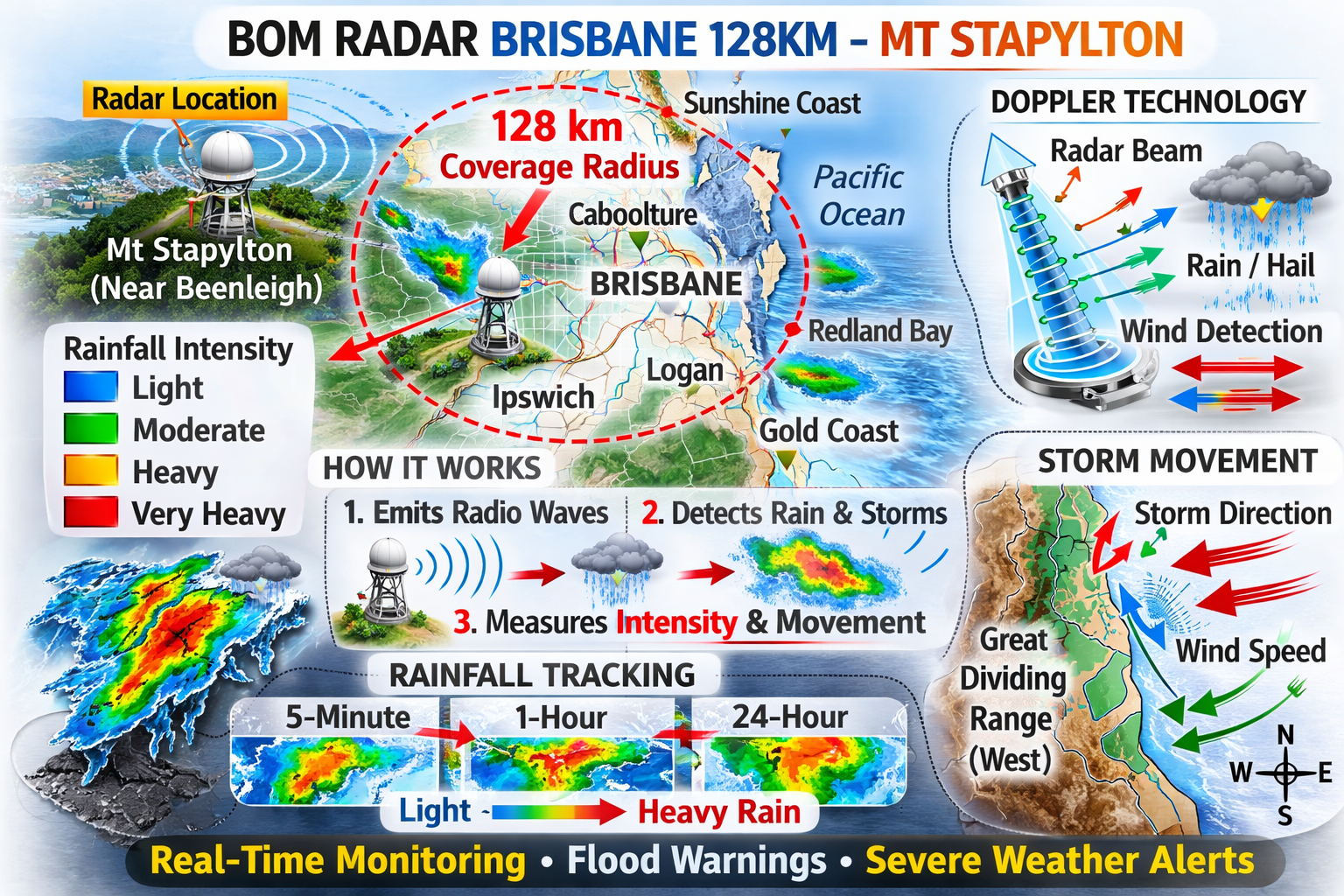
Colour Shading and Intensity
Radar maps typically use colour gradients to show rainfall intensity — lighter colours for low rainfall and darker shades for heavier rain. This allows users to visually identify storm centres and heavy rain bands quickly.
Movement and Trends
Animated radar loops show how rain systems move across the region over time. Watching these loops helps identify storm direction and speed, which is crucial for planning immediate responses.
Doppler Velocity Indicators
Doppler wind data use different shading to indicate motion toward or away from the radar. This helps isolate wind patterns within storm cells that could suggest areas of strong gusts or rotational features.
Understanding these elements enhances the practical use of radar data for both weather planning and real‑time decision making during dynamic weather events.
Strengths and Limitations of the Radar
Strengths
-
Continuous real‑time monitoring of rainfall over southeastern Queensland
-
Wide coverage across metropolitan, coastal, and inland regions
-
Doppler capabilities provide both rain and wind motion data
-
Supports severe weather detection and forecast refinement
These strengths make the Mt Stapylton radar a key asset for weather monitoring and public safety, particularly in regions prone to thunderstorms and intense rainfall.
Limitations
No radar system is perfect, and the Mt Stapylton radar has known limitations:
-
Terrain interference from the Great Dividing Range and Lamington Plateau can block low‑level echoes in certain directions.
-
Range limitations mean that very distant low‑level precipitation may be less accurately detected.
-
Radar signals can also pick up non‑meteorological echoes, such as stationary objects or sea clutter during strong winds, which can sometimes appear as false precipitation.
Understanding these limitations helps users interpret radar imagery more accurately by factoring in geographic and atmospheric context.
Interactions with Other Radars
Though the Mt Stapylton radar is the primary weather radar for the Brisbane region, it is supported by other radar assets:
-
The Brisbane (Marburg) radar was upgraded to dual‑polarised Doppler technology as a secondary system, providing complementary coverage when Mt Stapylton undergoes maintenance or outages.
-
Temporary radars — such as at Brisbane Airport — may also provide additional data during maintenance periods.
This network redundancy ensures continuous monitoring even when one radar is offline, helping maintain forecast continuity and public safety.
Educational and Local Uses
Beyond meteorological forecasting, the Mt Stapylton radar data is widely used by:
-
Local councils and emergency services for flood preparedness and response plans
-
Researchers studying atmospheric processes, storm development, and rainfall distribution
-
Educators and students learning about weather systems and atmospheric science
-
Weather enthusiasts tracking local storm events in real time
Radar data thus has broad applications beyond just official forecasting, helping inform decision making across community and scientific domains.
Bom Radar Brisbane 128km Mt Stapylton (FAQs)
1. What does “128km radar” mean?
It refers to the radar’s effective high‑resolution observation range, providing detailed data within approximately 128 kilometres of the radar site.
2. Where is the BOM radar at Brisbane located?
The 128km radar is positioned on an isolated hill near Beenleigh, southeast of Brisbane.
3. What type of radar technology does it use?
The radar uses Doppler S‑band technology, which detects both rain intensity and wind motion.
4. Can the radar detect winds?
Yes, Doppler radar can infer wind motion within storm systems by analysing how precipitation echoes shift in frequency.
5. Does terrain affect radar coverage?
Yes, nearby mountain ranges can reduce low‑level radar visibility in some directions.
6. Are there backup radars?
Yes, secondary radars like Marburg provide additional coverage when needed.
7. How often is radar data updated?
Radar loops are updated continuously in near real time, providing frequent rainfall and Doppler wind images.
Conclusion
In conclusion, the BOM radar Brisbane 128km Mt Stapylton is one of the most important weather observation tools in southeastern Queensland, providing critical real‑time data on rainfall and atmospheric motion. Its Doppler capabilities allow meteorologists to see both precipitation intensity and wind movement, supporting accurate forecast models and severe weather warnings.
The system’s strengths make it invaluable for emergency services, researchers, weather planners, and local residents who depend on reliable weather information. While terrain can affect coverage in some directions, the radar’s strategic location and integration with other network tools ensure broad operational effectiveness. For those who live, work, or travel in the region, understanding how the Mt Stapylton radar works enhances weather preparedness, situational awareness, and safety planning.
Major Nor’easter Poised To Bring Heavy Snow Across Westchester And Tri State Region
A powerful late-winter Nor’easter is forecast to unleash widespread snowfall across the Tri-State region, including Westchester County, New York City, Long Island, New Jersey, and Connecticut, beginning Sunday, February 22, 2026, and continuing into Monday, February 23, 2026. Forecasters warn this storm could rival some of the largest snow events in recent memory, with snow totals potentially exceeding one foot in many communities.
Updated regional projection maps show which towns and counties are likely to receive the heaviest snowfall. These maps have become a critical tool for residents and local authorities to plan snow removal, road safety measures, and public transportation adjustments. Local officials are urging communities to prepare for a prolonged winter storm with strong winds and dangerous travel conditions.
This guide provides a comprehensive guide to the storm, including the projected snowfall, timing, regional impacts, historical context, and recommended precautions for residents and travelers in the Tri-State area.
Major Nor’easter Poised To Bring Heavy Snow Across Westchester And Tri State Region
A powerful late-winter Nor’easter is forecast to unleash widespread snowfall across the Tri-State region, including Westchester County, New York City, Long Island, New Jersey, and Connecticut, beginning Sunday, February 22, 2026, and continuing into Monday, February 23, 2026. Forecasters warn this storm could rival some of the largest snow events in recent memory, with snow totals potentially exceeding one foot in many communities.
Updated regional projection maps show which towns and counties are likely to receive the heaviest snowfall. These maps have become a critical tool for residents and local authorities to plan snow removal, road safety measures, and public transportation adjustments. Local officials are urging communities to prepare for a prolonged winter storm with strong winds and dangerous travel conditions.
This article provides a comprehensive guide to the storm, including the projected snowfall, timing, regional impacts, historical context, and recommended precautions for residents and travelers in the Tri-State area.
What Is a Nor’easter and Why Is This One Significant?
A Nor’easter is a coastal storm system that forms when cold Arctic air collides with moist air from the Atlantic Ocean. These storms often bring a combination of heavy snow, rain, sleet, and strong northeast winds. They are common during late winter and early spring and can produce blizzard conditions, coastal flooding, and prolonged travel disruptions.
This particular Nor’easter is significant because:
-
It involves strong pressure gradients, intensifying both snowfall and winds.
-
Blizzard warnings have been issued for several major portions of the Northeast.
-
Forecast models have increased expected snowfall totals in recent updates.
-
The storm coincides with weekend and weekday commutes, raising public safety concerns.
Unlike typical mid-winter flurries, this storm is expected to produce sustained, heavy snow with potential impacts lasting more than 24 hours, particularly in urban and coastal communities.
Latest Forecast Warnings and Alerts
National and regional weather authorities have issued multiple alerts as of Friday, February 21, 2026:
Blizzard Warnings
Blizzard warnings are in effect for parts of New York City, Long Island, southern Connecticut, and Westchester County from early Sunday through Monday evening. These warnings indicate falling and blowing snow combined with strong winds that could reduce visibility to near zero, meeting the criteria for blizzard conditions.
Winter Storm Warnings
Inland areas, including northern New Jersey, interior Connecticut, and lower Hudson Valley communities, have winter storm warnings. These regions are expected to receive substantial snow, though totals may be slightly lower than coastal zones.
Winter Storm Watches
Further inland, winter storm watches have been issued as a precaution, signaling the potential for heavy snow. Forecasts in these areas remain subject to slight changes in the storm’s track and intensity.
These warnings underscore the severity of this Nor’easter and the potential for dangerous conditions across the entire Tri-State region.
Projected Snowfall Totals: What Locals Might See
Updated projection maps indicate heavy snow is likely across most of the Tri-State area, with the highest totals along the coast and in urban centers. Snowfall will vary depending on exact location, elevation, and storm track.
New York City & Surrounding Areas
-
New York City: 10 to 18 inches of snow, with some boroughs potentially receiving more.
-
Westchester County: Interior communities could see 12 to 20 inches, especially in northern areas near the Hudson Valley.
-
Long Island (Nassau & Suffolk Counties): Coastal towns could exceed 15 inches, with some areas approaching 18 inches.
-
Snowfall rates could reach 1 to 2 inches per hour at the storm’s peak.
New Jersey & Connecticut
-
Northern and Coastal New Jersey: 10 to 20 inches, with local variations depending on elevation.
-
Coastal Connecticut: 13 to 18 inches in southern counties.
-
Southern Connecticut inland: 6 to 12 inches, with strong winds contributing to snowdrifts and blowing snow.
Even beyond the core Tri-State zone, heavy snow is expected from eastern Pennsylvania through Massachusetts, making this a multi-state storm with significant impacts.
Timing and Storm Phases
Meteorologists have identified three key phases for the storm:
Phase 1: Sunday Morning to Afternoon
Snow begins in some inland areas early Sunday, potentially mixed with rain near the immediate coast initially. As the storm strengthens offshore, precipitation is expected to transition to steady snowfall by midday.
Phase 2: Sunday Night Peak
Snow intensifies Sunday evening, with the heaviest accumulations expected overnight. Visibility may drop significantly due to blowing snow and strong winds, making travel dangerous.
Phase 3: Monday Morning and Afternoon
Snow continues into Monday, tapering off later in the afternoon. However, strong winds could cause ongoing snowdrifts and whiteout conditions, particularly during the morning commute.
The timing of the storm could severely affect commuters, public transit, and emergency services, making early preparation critical for residents and businesses.
Winds, Visibility, and Blizzard Conditions
Beyond snow totals, this storm is expected to bring:
-
Strong wind gusts up to 60 mph near the coast and on Long Island.
-
Reduced visibility and whiteout conditions during peak snowfall.
-
Heavy, wet snow that may accumulate on tree limbs and power lines, increasing the risk of outages.
Even areas with moderate snowfall could experience blizzard-like conditions due to strong winds and blowing snow. Residents should be prepared for hazardous road conditions and potential disruptions in power and communications.
Local Impacts: School Closures, Transit, and Travel
School and Workplace Closures
Many school districts across Westchester, NYC, Long Island, and Connecticut may close or delay classes as the storm approaches. Districts will make final decisions based on updated forecasts and snowfall totals.
Commute Disruptions
Public transit, including commuter rail, buses, and subways, may face delays or temporary service suspensions. Road travel is expected to be dangerous, with snow accumulation, icy patches, and low visibility affecting most routes.
State transportation departments are deploying snow removal equipment, but persistent heavy snow and high winds will challenge clearance operations throughout the storm.
Recommended Preparations for Residents
Local authorities advise residents to:
-
Avoid unnecessary travel during the storm.
-
Stock up on essentials, including food, water, and medications.
-
Secure outdoor furniture, trash cans, and other loose items.
-
Prepare for potential power outages with flashlights, batteries, and emergency kits.
-
Check on elderly or vulnerable neighbors.
-
Provide shelter and care for pets and livestock where applicable.
Taking these precautions can help households manage extended periods of hazardous conditions and limited mobility.
Historical Context: Snow Patterns in Early 2026
The 2025–2026 winter season has already seen multiple significant snow events in the Northeast, with some Hudson Valley towns reporting double-digit accumulations in January. This Nor’easter continues a trend of active late-winter storm systems, reminding residents and municipalities that preparation and vigilance remain essential.
What Meteorologists Are Watching Next
While forecast confidence is high, details such as the exact track and snowfall distribution could change.
-
A slightly easterly track could push the heaviest snow offshore.
-
A track closer to the coast may bring higher totals to urban and coastal areas.
-
Temperature variations may affect snow-to-rain ratios, especially near the shoreline.
Meteorologists will update projections frequently as new data arrives, meaning residents must remain attentive to evolving forecasts.
7 Frequently Asked Questions (FAQs)
-
When will the snow start?
Snow likely begins Sunday morning, spreading through Sunday night and continuing into Monday. -
How much snow will New York City receive?
Forecasts indicate 10–18 inches of snow, depending on location and elevation. -
Are blizzard conditions expected?
Yes. Blizzard warnings are in effect for NYC, Long Island, and southern Connecticut. -
Will the snow affect weekday travel?
Yes. Heavy snow and strong winds during Monday morning could severely impact commutes. -
Should residents prepare for power outages?
Yes. Heavy, wet snow on trees and power lines may cause outages in multiple areas. -
Will other states beyond the Tri-State be affected?
Yes. Eastern Pennsylvania, Massachusetts, and Rhode Island could see significant snow and travel impacts. -
When will the snow end?
Snow should taper off Monday afternoon, though blowing snow may persist into the evening.
Conclusion
The approaching Nor’easter poses a serious threat of heavy snow, strong winds, and hazardous travel across the Tri-State region, including Westchester County, New York City, Long Island, New Jersey, and Connecticut. Blizzard and winter storm warnings indicate that conditions could be severe between Sunday and Monday, with some areas receiving well over a foot of snow.
Residents are strongly encouraged to prepare early by stocking up on essentials, limiting travel, and monitoring updated forecasts. This storm could disrupt daily life, transportation, and power services, making readiness essential. Communities and households that take proactive precautions will be better equipped to manage snow accumulation, visibility hazards, and winter storm impacts. Staying informed, planning ahead, and following official advisories will help minimize risks during this major winter event.
Former NFL Player And Laboratory Owner Convicted In $328M Genetic Testing Fraud Scheme
In February 2026, a federal jury in Dallas delivered a landmark verdict in a massive Medicare fraud case, convicting former professional football player Keith J. Gray, a Texas laboratory owner, in connection with a $328 million genetic testing fraud scheme. The conviction represents one of the most significant healthcare fraud enforcement actions in recent American history, highlighting vulnerabilities in Medicare reimbursement, telemedicine oversight, and laboratory billing practices.

Gray’s operation involved billing Medicare for high-cost genetic tests that were not medically necessary, tests that were purportedly designed to evaluate cardiovascular risk. Prosecutors presented evidence showing that Gray and his associates paid illegal kickbacks to marketing companies in exchange for patient referrals, including Medicare beneficiaries’ personal information, DNA samples, and signed test orders, which were often obtained through manipulated or superficial telemedicine interactions.
This article provides an in-depth exploration of the scheme’s mechanics, key players, legal charges and convictions, federal investigative strategies, sentencing risks, industry implications, and critical lessons for healthcare compliance and fraud prevention.
Former NFL Player And Laboratory Owner Convicted In $328M Genetic Testing Fraud Scheme
Who Is Keith J. Gray?
Keith J. Gray, age 39, of McKinney, Texas, is the central defendant in this case. Gray was once a standout college football player at the University of Connecticut, where he served as a team captain and started multiple seasons as an offensive lineman. After college, he briefly pursued a professional football career, signing as an undrafted free agent with the Carolina Panthers and later spending time on the Indianapolis Colts practice squad, although he did not play in a regular-season NFL game.
Following his football career, Gray transitioned into the healthcare diagnostics sector. He founded and operated two clinical laboratory entities: Axis Professional Labs LLC and Kingdom Health Laboratory LLC. While these labs ostensibly provided genetic testing services, federal prosecutors showed that their primary role became generating fraudulent Medicare reimbursement claims rather than serving legitimate medical needs.
Anatomy of the Genetic Testing Fraud Scheme
Billing Medicare for Medically Unnecessary Tests
The core of the fraud centered on billing Medicare for genetic tests designed to identify cardiovascular health risks even when those tests were not medically necessary. Prosecutors detailed how Axis and Kingdom submitted approximately $328 million in false and kickback-tainted claims. Medicare ultimately paid about $54 million before the fraud was detected.
Gray’s scheme targeted Medicare because of its broad coverage of diagnostic services and relatively high reimbursement rates for comprehensive genomic testing panels.
Illegal Kickbacks to Marketers
A central feature of the case was the use of illegal kickbacks. Gray paid marketing firms and individual recruiters for referring Medicare beneficiaries’ DNA samples and personal data, including Medicare numbers. These fees were tied directly to the volume of samples and referrals sourced, creating improper financial incentives disconnected from legitimate clinical evaluation.
To conceal this illicit arrangement, Gray and his associates used sham contracts and fabricated invoices. Payments were disguised as compensation for “marketing” services, “software” expenditures, or even fake loans — all designed to make kickback payouts appear legitimate.
“Doctor Chase” and Physician Pressure
Prosecutors described a tactic known as doctor chase, where marketing intermediaries pursued primary care physicians to obtain signed orders for genetic tests. In many cases, physicians were pressured to approve test orders after marketers had “qualified” patients via phone calls conducted by non-medical personnel.
This practice circumvented normal clinical oversight and allowed the tests to be billed as if they were ordered legitimately by treating physicians.
Money Laundering and Personal Expenditures
Part of the false Medicare reimbursements were subsequently used by Gray to fund a lavish lifestyle. Evidence at trial showed that he used some of the illicit proceeds to purchase luxury vehicles, including:
-
A Dodge Ram truck worth more than $142,000
-
A Mercedes-Benz SUV worth more than $145,000
These purchases were cited as part of money laundering charges, demonstrating how the proceeds of fraud were funneled back into personal assets.
Federal Investigation and Interagency Collaboration
The successful prosecution of this case resulted from a coordinated federal investigation involving multiple agencies:
-
Federal Bureau of Investigation (FBI) — Dallas Field Office
-
U.S. Department of Health and Human Services Office of Inspector General (HHS-OIG) — Dallas Region
-
Texas Medicaid Fraud Control Unit (MFCU)
-
Department of Veterans Affairs Office of Inspector General (VA-OIG) — South Central Field Office
The Department of Justice’s Criminal Division Fraud Section oversaw the prosecution. Senior officials announced the verdict, emphasizing the coordinated effort to dismantle sophisticated healthcare fraud networks. This multi-agency partnership reflects the federal government’s broader strategy to combat healthcare fraud through data analytics, cross-agency cooperation, and targeted enforcement actions.
Convictions and Legal Charges
After a multi-week trial, the jury convicted Keith J. Gray of the following offenses:
-
Conspiracy to defraud the United States and to pay and receive healthcare kickbacks
-
Five counts of violating the Anti-Kickback Statute
-
Three counts of money laundering
These convictions stemmed from overwhelming evidence presented by prosecutors, including internal documents, fabricated contracts, billing records, text messages, and testimony illustrating how Gray orchestrated and benefited from the scheme.
Potential Sentencing and Penalties
Gray now faces significant federal penalties. For each count of conspiracy, anti-kickback violation, and money laundering, he faces up to 10 years in prison. The final sentence will be determined by a federal district court judge after consideration of the U.S. Sentencing Guidelines and statutory factors, including the scale of the fraud and the defendant’s role.
In addition to prison time, potential penalties could include:
-
Substantial fines
-
Restitution to Medicare
-
Asset forfeiture
-
Exclusion from participation in federal healthcare programs
Broader Implications of the Case
This conviction has far-reaching implications for healthcare providers, laboratories, telehealth services, and federal enforcement:
1. Enforcement Focus on Genetic Testing Fraud
Federal authorities have increasingly targeted fraud involving genetic and laboratory testing, particularly as advanced diagnostics become more widely reimbursed by Medicare and other insurers. Prosecutors have emphasized that schemes exploiting high-value tests can drain billions in public funds and jeopardize patient safety and data integrity.
2. Risks of Telemedicine Abuse
The case highlights vulnerabilities in telemedicine, where remote authorizations can be manipulated to facilitate fraudulent billing. Enforcement agencies are scrutinizing how telehealth platforms are used to generate test orders without proper clinical evaluations or patient care continuity.
3. Compliance Challenges for Laboratories
Legitimate laboratories must maintain strict compliance systems, including:
-
Verifiable documentation of medical necessity
-
Transparent billing practices
-
Proper physician orders
-
Internal audits and compliance training
Adherence to federal anti-kickback laws and healthcare fraud statutes is essential to avoid similar legal jeopardy.
Former NFL Player And Laboratory Owner Convicted In $328M Genetic Testing Fraud Scheme (FAQs)
1. Who was convicted in the $328 million genetic testing fraud case?
Keith J. Gray, a former University of Connecticut standout and ex-NFL player turned laboratory owner, was convicted by a federal jury for orchestrating the scheme.
2. What companies were involved in the fraud?
The laboratories used were Axis Professional Labs LLC and Kingdom Health Laboratory LLC, both owned and operated by Gray.
3. How much did Medicare pay in fraudulent claims?
While the labs billed approximately $328 million, Medicare ultimately paid around $54 million before the fraud was exposed.
4. What laws were violated?
Gray was convicted of conspiracy to defraud the United States, anti-kickback statute violations, and money laundering.
5. What is “doctor chase”?
“Doctor chase” refers to aggressive efforts by marketers to locate and pressure physicians into signing off on test orders, often after patients were “qualified” for a test through calls by non-medical personnel.
6. Which federal agencies investigated the case?
The FBI, HHS-OIG, Texas Medicaid Fraud Control Unit, and VA-OIG collaborated on the investigation.
7. What penalties does Gray face?
Gray faces up to 10 years in prison per count, fines, restitution, and possible exclusion from federal healthcare programs.
Conclusion
The conviction of Keith J. Gray in the $328 million genetic testing fraud scheme underscores the federal government’s commitment to combating healthcare fraud that exploits Medicare’s reimbursement system and erodes public trust. The case highlights how sophisticated fraud networks can operate across telemedicine, laboratory billing, and referral marketing without stringent oversight — until federal investigators intervene.
As enforcement activity continues to intensify, healthcare providers and diagnostic companies must prioritize compliance, ethical patient care, and transparency in billing practices. For healthcare executives, laboratory professionals, and compliance officers, this verdict serves as a stark reminder that financial incentives must never override clinical integrity and legal compliance. Vigilance, transparency, and strict adherence to federal laws are essential safeguards in the modern healthcare industry.