Nicki Minaj Draws Attention to Trump-Era ‘Gold Card’ Claiming Faster Path to U.S. Citizenship
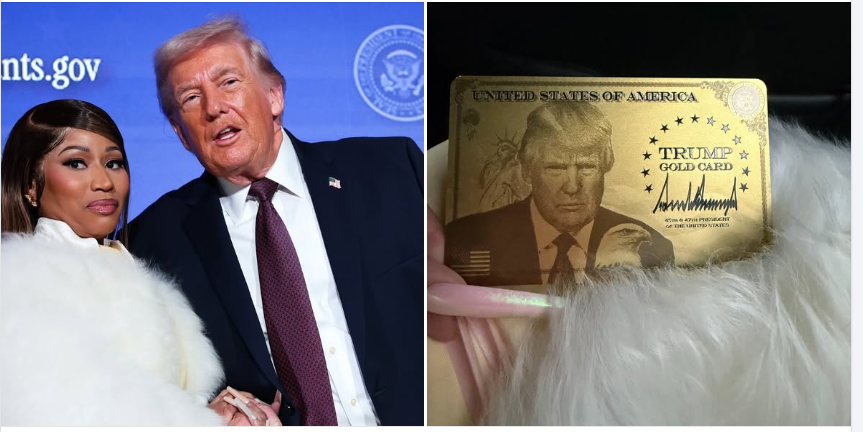
Nicki Minaj reignited national and online debate after posting an image of President Donald Trump’s so-called “Gold Card,” a controversial document that has been promoted as offering an accelerated pathway to U.S. residency and, eventually, citizenship. The post, captioned simply “Welp…,” quickly went viral and drew intense scrutiny from fans, critics, and political observers alike.
The image surfaced shortly after Minaj appeared publicly alongside President Trump to promote his newly announced “Trump accounts,” further amplifying speculation about her political alignment and immigration status. While the post did not explicitly confirm whether she purchased or received the card, its timing and symbolism fueled widespread discussion.
At the center of the controversy is the Trump-era “Gold Card” itself—an initiative supporters describe as a premium immigration option tied to a significant financial contribution to the U.S. Treasury. Critics, however, question both its legality and its implications for fairness in the U.S. immigration system.
This article examines what is known about the Trump “Gold Card,” what Nicki Minaj actually posted, what has and has not been verified, and how the moment fits into broader debates about celebrity influence, immigration policy, and wealth-based access in the United States.
Nicki Minaj Draws Attention to Trump-Era ‘Gold Card’ Claiming Faster Path to U.S. Citizenship
What Did Nicki Minaj Post?
Nicki Minaj shared a photo appearing to show a physical Trump-branded “Gold Card,” accompanied by the caption “Welp…”. The post did not include an explanation, confirmation of ownership, or details about how the card was obtained.
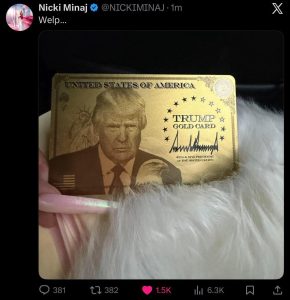
Nicki Minaj Shows Off her Trump Gold Card
Because of Minaj’s global influence and the political sensitivity of the subject, the image spread rapidly across social media and news platforms. Many interpreted the post as signaling participation in—or support for—the Trump-backed immigration initiative.
Importantly, Minaj has not publicly confirmed that she purchased the card, paid any associated fees, or initiated any citizenship process. As of now, claims about her personal immigration status remain speculative.
What Is the Trump-Era “Gold Card”?
The Trump “Gold Card” is described by its promoters as a premium immigration document tied to a large financial contribution. Reports circulating online claim it involves:
-
A contribution of up to $1 million to the U.S. Treasury
-
A non-refundable processing fee reportedly around $15,000
-
A promise of accelerated permanent residency, with a potential future path to citizenship
However, it is critical to note that U.S. immigration law does not currently recognize a visa or citizenship status officially named the “Gold Card.” Its legal standing, structure, and authority remain unclear and contested.
Citizenship vs. Residency: A Crucial Distinction
Much of the public confusion surrounding the “Gold Card” stems from a misunderstanding of U.S. immigration categories.
Under U.S. law:
-
Permanent residency (Green Card) does not equal citizenship
-
Citizenship requires years of residence, background checks, English proficiency, and civic testing
-
No program grants instant or guaranteed U.S. citizenship, regardless of wealth
Even investment-based programs, such as the long-standing EB-5 Immigrant Investor Program, involve extensive vetting and multi-year waiting periods.
As of now, no verified evidence shows that the Trump “Gold Card” bypasses these legal requirements.
Why the Post Sparked So Much Reaction
Nicki Minaj’s post resonated because it sits at the intersection of three highly charged issues:
-
Immigration fairness
-
Economic inequality
-
Celebrity political influence
For supporters, the post symbolized success, access, and alignment with Trump’s economic vision. For critics, it represented perceived pay-to-play immigration and unequal treatment based on wealth or status.
The lack of clear, official information about the card allowed speculation to flourish, with social media filling gaps left by silence and ambiguity.
Celebrity Influence and Political Signaling
Celebrities wield enormous power in shaping public narratives, often without issuing explicit policy statements. A single image or caption can drive headlines, influence opinion, and shift discourse.
In this case, Minaj’s post was interpreted variously as:
-
A political endorsement
-
A symbolic flex
-
A critique or ironic commentary
-
Or a personal immigration update
Without clarification, the post functioned as a cultural Rorschach test—revealing more about public assumptions than confirmed facts.
Legal and Ethical Questions Raised
The “Gold Card” discussion raises broader concerns about immigration ethics, including:
-
Whether wealth should provide faster access to residency
-
How immigration programs are communicated to the public
-
The risk of misinformation when unofficial initiatives resemble legal processes
Immigration attorneys and policy experts have cautioned against assuming legitimacy without statutory backing or regulatory clarity.
What Has NOT Been Verified
As of now, the following claims remain unconfirmed:
-
That Nicki Minaj paid $1 million for the card
-
That the card guarantees fast-tracked citizenship
-
That the program replaces or overrides existing immigration law
Responsible reporting distinguishes between what is shown, what is suggested, and what is legally established.
Nicki Minaj Draws Attention to Trump-Era ‘Gold Card’ Claiming Faster Path to U.S. Citizenship FAQs
1. Did Nicki Minaj confirm she bought the Trump Gold Card?
No. She posted an image of the card but did not confirm payment, ownership, or immigration status.
2. Is the Trump “Gold Card” an official U.S. visa?
There is no officially recognized U.S. visa or citizenship status called the “Gold Card.”
3. Does the card provide instant U.S. citizenship?
No verified program grants instant or guaranteed U.S. citizenship.
4. Is this the same as the EB-5 investor visa?
No. EB-5 is a long-standing legal program with strict rules and timelines.
5. Why did the post go viral?
Because it combined celebrity influence, immigration controversy, and political symbolism.
6. Can wealth speed up U.S. immigration?
Wealth may qualify applicants for certain visas, but it does not eliminate legal requirements.
7. Should people rely on social media for immigration information?
No. Immigration decisions should be based on official government sources and qualified legal advice.
Conclusion
Nicki Minaj’s post of a Trump-era “Gold Card” illustrates how quickly symbolism can overtake substance in the digital age. While the image sparked intense speculation about fast-tracked U.S. citizenship, the legal reality remains far more complex and restrained.
No verified evidence shows that the card guarantees citizenship or bypasses immigration law. As celebrity influence continues to shape public discourse, separating verified facts from viral assumptions is more important than ever. Readers are encouraged to rely on credible sources, question unverified claims, and seek expert insight when engaging with immigration-related narratives.